Free tool, no signup
Free email subject line tester
Test a subject line before you send it. Get an open-rate read, spam-trigger check, mobile preview and stronger rewrites.
How it decides
Counted, then graded
Code counts the characters, words, capitals and emoji, then a strict grader judges whether the line earns an open.
What scores well
Specificity
A concrete detail such as a name, a number, a date or a decision earns more opens than a clever phrase.
Rubric Specificity. A name, number, date, or decision beats cleverness almost every time.
The four-word test
The reader should know within the first four words whether the email is about them.
Rubric The reader can tell in four words whether this concerns them.
Person to person
It should sound like one person writing to another, not a campaign sent to a list.
Rubric It reads as written by a person to a person, not by a marketing team to a list.
Front-loaded
The important words go first, because phones and inbox lists cut the end off.
Rubric The front of the line carries the meaning, because the end may be cut off.
What scores badly
Vague nouns
Empty phrases like quick question or checking in tell the reader nothing.
Rubric Vague nouns doing the work: "quick question", "touching base", "checking in", "opportunity", "solution", "synergy".
Clickbait
Teasing the reader with a hook the email itself does not deliver.
Rubric Clickbait or a curiosity gap the body does not pay off.
Manufactured urgency
Fake deadlines and pushy urgency count against it.
Rubric Manufactured urgency, or a deadline the sender invented.
Shouting and hype
Capitals for shouting, piled-up exclamation marks, or a money figure next to a word like biggest or best.
Rubric Stacked capitals, several exclamation marks, or a currency figure plus a superlative.
Generic personalisation
A name dropped in by mail merge (software that fills in names) that still reads as a template.
Rubric Generic personalisation that is obviously a mail merge.
The subject line reaches the model labelled as untrusted content to judge, never instructions, and the model is told to ignore anything inside it that tries to change its role or the rules. The line is never sent to analytics and the response is marked no-store. The rubric above is not a summary of the instructions the model is given: it is those instructions, word for word, generated from the same file. Change one and you change the other.
Questions
What people ask
The answers worth having before, and after, you use the tool.
How long should an email subject line be?
Between 30 and 50 characters. Gmail on a phone shows roughly 35 to 40 before it cuts, and Outlook's desktop list is similar, so put the words that matter first and treat anything past 50 as a bonus the reader may never see.
What makes a subject line get opened?
Specificity. A name, a number, a date or a decision beats a clever line almost every time. The reader is scanning a list and deciding whether this concerns them; a subject that answers that in four words wins.
Which words trigger spam filters?
Modern filters score the whole message and the sender's reputation, not a banned word list, so one word rarely sends you to spam on its own. Stacking them does: all caps, several exclamation marks, "free," "guaranteed," "act now" and a currency figure in one line is a pattern filters recognise.
What should I put in a job application subject line?
The role and your name: "Senior Analyst application, Priya Raman". Recruiters filter and sort by subject, so anything that helps them find you again later is worth more than anything clever.
Should I use emoji in a subject line?
In consumer newsletters they can lift opens slightly. In cold outreach, job applications and anything internal, they cost you credibility and can render as a box on older clients. If in doubt, leave them out.
This tool handles one email. Batmail handles the rest.
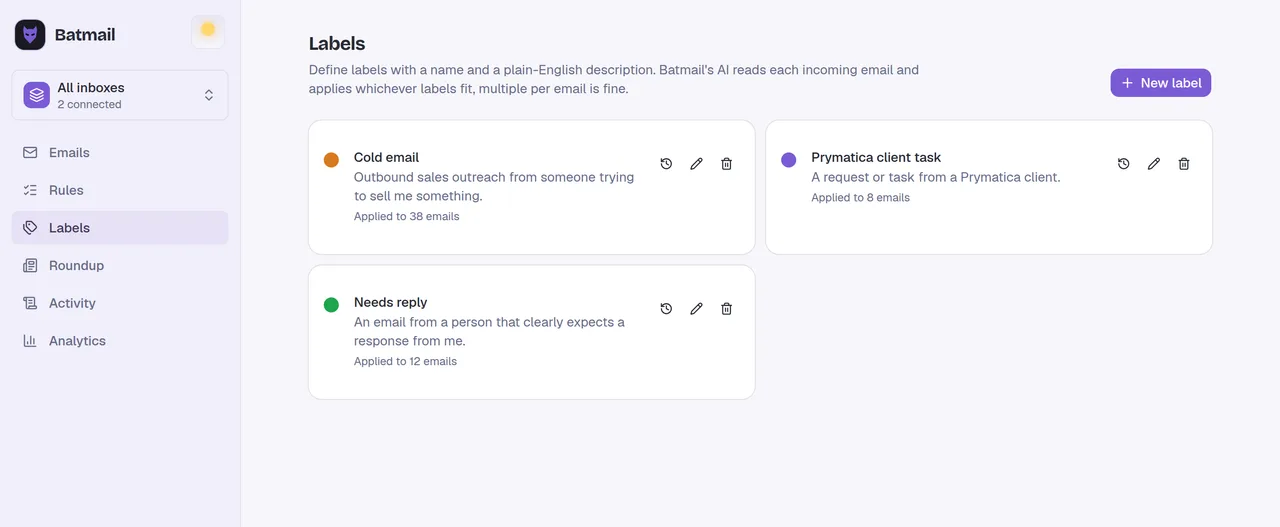
A good subject line earns one open. Batmail works the other side of the inbox: it reads what arrives, decides what it is, and tells you which ones actually need a reply. Emailchaser has its own version of this one: its cold email subject line tester scores a line on length, spam words and personalisation, and writes stronger ones. Emailchaser is built by the same team as Batmail.
More free tools
Other things you can do here
All free, all without an account.