Free tool, no signup
Free email sign-off picker
Pick a situation and a tone, see when each sign-off fits and when it reads wrong, then copy it with your name.
Your sign-off
How the end of your email will look
Best regards,
Your name
10 sign-offs fit
Press Preview to try one above.
Sincerely,
Formal- Fits
- A first email to someone you have not met, in American business writing.
- Reads wrong
- A message between colleagues on first-name terms, where it feels stiff.
Yours sincerely,
Formal- Fits
- British English, after a greeting that uses the person's name, such as Dear Ms Rook.
- Reads wrong
- A quick internal message, where it reads as old fashioned.
Yours faithfully,
Formal- Fits
- British English, after Dear Sir or Madam when you do not know a name.
- Reads wrong
- Any email where you do know the name. Use Yours sincerely there.
Respectfully,
Formal- Fits
- A message to a judge, an official or someone far senior.
- Reads wrong
- Ordinary work email, where it sounds distant, even cold.
Respectfully yours,
Formal- Fits
- A formal letter to an official, in American usage.
- Reads wrong
- Almost any other email, where it looks dated.
With kind regards,
Formal- Fits
- A first message to a client or partner that should sound courteous.
- Reads wrong
- A two line reply, where it makes the email feel heavier than it is.
Best regards,
Neutral- Fits
- Work email you want to sound professional but not stiff.
- Reads wrong
- A close friend or a very warm thread, where it can read as cool.
Kind regards,
Neutral- Fits
- Clients and new contacts, a little warmer than Regards.
- Reads wrong
- A legal or official letter, where Sincerely or Respectfully fits better.
Regards,
Neutral- Fits
- A short, routine message between colleagues.
- Reads wrong
- A tense thread, where a bare Regards can read as curt.
Warm regards,
Friendly- Fits
- People you work with and like, when Best regards feels too cool.
- Reads wrong
- A complaint or a first email to someone senior.
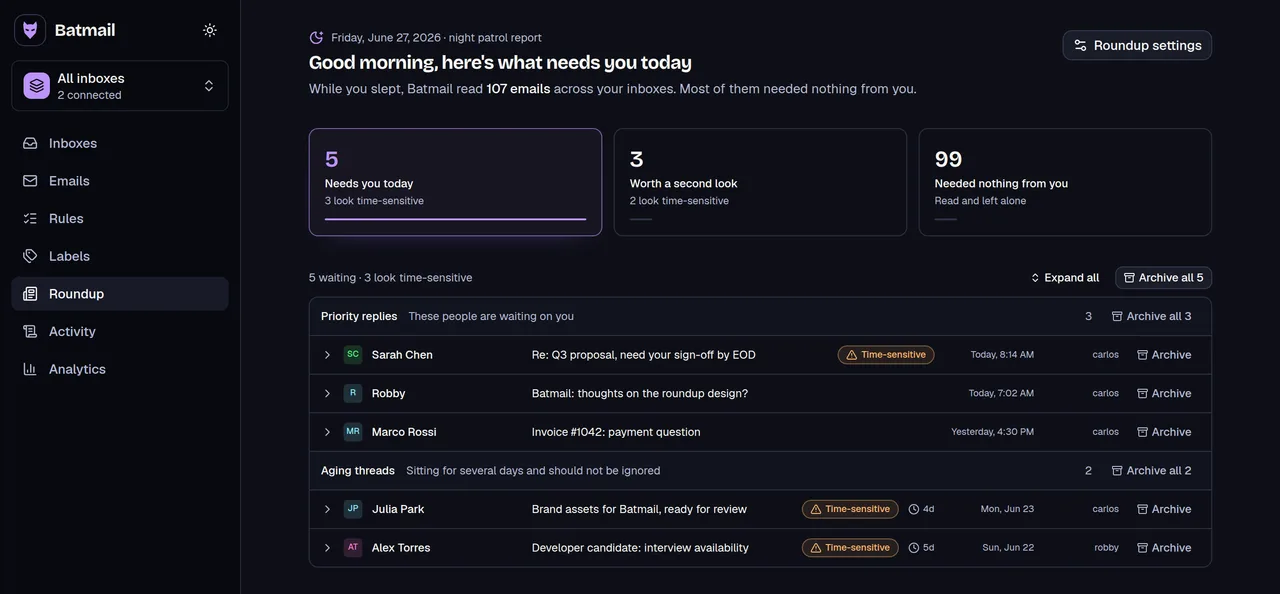
This tool handles one email. Batmail handles the rest.
How to use it
Here is how to pick a sign-off in under a minute.
The list narrows as you choose, so you can compare the sign-offs for one situation side by side.
- Choose the situation your email is in: formal, friendly, thank you, asking for something, cold email, apology, follow-up or team.
- Choose a tone, or leave it on any tone to see every sign-off in that situation.
- Read when each sign-off fits and when it reads wrong. The second line catches the one that suits the situation but not the person.
- Type your name and one line under it, such as your role and company, then press Preview on the sign-off you like.
- Copy the sign-off on its own, or copy it with your name and line under it.
From most formal to most casual
Respectfully,
A message to a judge, an official or someone far senior.
Kind regards,
Clients and new contacts, a little warmer than Regards.
Best,
Everyday email to colleagues and clients you already know.
Thanks,
A quick reply between colleagues.
Cheers,
Casual email in British, Australian and New Zealand workplaces.
These three emails show how the picker narrows the list.
A first email to a stranger narrows to formal sign-offs.
Sunniva Brackenlow is writing to the finance director at Hallowmere Print Co. She picks Formal for the situation and Formal for the tone, and the list drops from 60 sign-offs to 6. She previews "Sincerely", types her name and role, and copies the block.
A thank you to a colleague can be warmer.
Kasimir Aldercott is thanking a teammate who covered his shift. He picks Thank you and the friendly tone, which leaves 2 sign-offs. He chooses "Thanks so much", then checks its Reads wrong line: a formal letter, where it reads as chatty.
A cold email ends on one small question.
Ottilie Fenwright is writing to a designer at Larchway Studio who has never heard of her. She picks Cold email and the friendly tone, and finds 4 sign-offs. She picks "Worth a quick chat?", which already ends in a question mark, so the picker adds no comma.
These 60 sign-offs fall into eight situations.
Each card names a situation and lists every sign-off the picker holds for it. Open the picker above to see when each one fits and when it reads wrong.
- Formal, 10
Formal sign-offs suit first emails, senior readers and anything official.
- Sincerely
- Yours sincerely
- Yours faithfully
- Respectfully
- Respectfully yours
- With kind regards
- Best regards
- Kind regards
- Regards
- Warm regards
- Friendly, 9
Friendly sign-offs suit people who already know you.
- Best
- All the best
- Cheers
- Take care
- Talk soon
- Speak soon
- Have a great week
- Have a good weekend
- Looking forward to it
- Thank you, 8
Thank you sign-offs close a message that follows help or time given.
- Thank you
- Thanks
- Many thanks
- Thanks so much
- Thank you for your time
- Thank you again
- With appreciation
- With gratitude
- Asking for something, 8
Request sign-offs suit a message that needs an answer.
- Thank you in advance
- Thanks in advance
- Please let me know
- Looking forward to your reply
- Looking forward to hearing from you
- I would appreciate your help
- Appreciate your help
- Thank you for your help
- Cold email, 7
Cold email sign-offs should ask for as little as possible.
- Best wishes
- Appreciate your time
- Thanks for reading
- Curious to hear your thoughts
- Worth a quick chat?
- Happy to send more detail
- Looking forward to connecting
- Apology, 6
Apology sign-offs stay short and say sorry once.
- My apologies
- Apologies again
- Sorry again for the trouble
- With apologies
- Thank you for your patience
- I appreciate your understanding
- Follow-up, 6
Follow-up sign-offs nudge without nagging.
- Just checking in
- Hope this helps
- Let me know if this works
- Looking forward to your update
- Happy to help further
- Talk to you then
- Team and internal, 6
Team sign-offs fit quick messages between colleagues.
- Thanks all
- Thanks team
- Have a good one
- See you tomorrow
- Ping me if you need anything
- Catch you later
These are the sign-off mistakes readers notice.
The sign-off is warmer than the relationship.
Cheers or Talk soon to someone you have never met reads as presumptuous. Match the way they write to you, and move up a step only when they do.
The sign-off and the greeting do not match.
Dear Dr Vance followed by Catch you later sounds like two different people wrote the email. A formal greeting wants a formal close, and a Hi wants a light one.
The sign-off promises something the email does not.
Talk soon and Looking forward to it promise a conversation. If none is planned, choose a close that asks for the one thing you need.
Two sign-offs sit on top of each other.
Thanks, then Best regards, then a name is one close too many. Pick one line, then your name, then your signature.
Two other free tools write the lines around your sign-off.
- The email greeting picker chooses the first line that should match your closing.
- The email signature generator builds the block that sits under your name.
Questions
These are the questions people ask.
The answers worth having before, and after, you use the tool.
What is the best way to sign off an email?
Best regards or Kind regards for work email, Thanks when someone has helped, and a plain Best for people you already know. Match the closing to the greeting: Dear wants Sincerely or Kind regards, and Hi wants Best or Thanks.
Does a comma go after the sign-off?
Yes. Write Best regards, then your name on the next line. A sign-off that ends in a question mark or an exclamation mark, such as Worth a quick chat?, needs no comma.
What is the difference between Yours sincerely and Yours faithfully?
In British English, Yours faithfully follows Dear Sir or Madam, when you do not know a name, and Yours sincerely follows a greeting with a name. American English uses Sincerely for both.
Is Regards rude?
It is not rude, but it is short. A bare Regards can read as curt in a tense thread. Kind regards or Best regards costs one word and reads warmer.
What can I write instead of Thanks in advance?
Thank you for your time, Please let me know or Appreciate your help. Thanks in advance can sound as if you expect a yes, so many readers prefer a closing that thanks them without assuming.
Is anything I type sent anywhere?
No. The sign-offs are filtered in your browser from a list a person wrote. Your name and the line under it stay on this page, and there is no account to create.
This tool handles one email. Batmail handles the rest.
A sign-off ends one email, and the reply comes back to a busy inbox. Batmail reads what arrives overnight and puts the replies that need you at the top of one morning brief.
More free tools
There are more free tools here.
All free, all without an account.