Free tool, no signup
Free bounce back email decoder
Paste a bounce from Mail Delivery Subsystem. See why the email failed, whether it will retry and what to fix.
What the bounce says
Paste a bounce above, or try the sample, and the reason it failed shows here.
This tool handles one email. Batmail handles the rest.
Continue with GoogleHow to use it
Here is how to read a bounce in a minute.
Paste the whole bounce, including the technical part near the bottom. The result appears as you paste.
- Open the bounce in your mail app. It usually comes from Mail Delivery Subsystem, Mail Delivery System or MAILER-DAEMON.
- Select everything in it, including the lines with codes such as 550 5.1.1, and paste it into the box above.
- Read the verdict: what went wrong, and whether it is permanent or the server will keep trying.
- Follow the steps under the verdict, and send again only when the cause is fixed.
Reading 550 5.1.1
- Reply code
550
Requested action not taken: mailbox unavailable
- Class
5
Permanent Failure. A 4 here would mean temporary.
- Subject
1
Addressing Status: about the address.
- Detail
1
Bad destination mailbox address
These three bounces show what the codes mean.
A typo in the address gives 550 5.1.1.
Sunniva Brackenlow emails a buyer and gets a bounce carrying 550 5.1.1. The decoder names it Bad destination mailbox address: the address does not exist or no longer takes mail. She checks the buyer's last email, finds the surname spelled with a c, not an s, and sends again.
A full mailbox gives 452 4.2.2.
Kasimir Aldercott's quote to a customer bounces with 452 4.2.2, Mailbox full. The 4 at the front means the failure is temporary, so the sending server keeps trying. He tells the customer by phone to clear some space and does not resend.
A domain setting gives 550 5.7.26.
A newsletter from Hallowmere Print Co bounces with 550 5.7.26, Multiple authentication checks failed. The address is fine. The receiving server could not confirm the email really came from the shop's domain, so the shop forwards the bounce to whoever runs its domain to fix the SPF, DKIM and DMARC records.
Where the codes live
- X.0 No more detail1
- X.1 The address11
- X.2 The mailbox5
- X.3 The receiving system7
- X.4 The network8
- X.5 The conversation between servers7
- X.6 The content10
- X.7 Security and policy31
These are the mistakes people make after a bounce.
The same email was sent again straight away.
After a permanent failure, the same email to the same address fails the same way. Fix the address, the attachment or the setting first.
A temporary failure was treated as final.
A code that starts with 4 means the server is still trying. Sending again makes a duplicate if the first one arrives later.
Only the friendly part was read.
The top of a bounce is often a general message. The codes and the receiving server's own words sit lower down, and they hold the real reason.
A bounce for an email you never sent was trusted.
Spammers forge return addresses, so you can get bounces for mail you never sent. Do not open the links or attachments in those. Delete them.
Two other free tools help with the email behind the bounce.
- The email header analyzer shows the SPF, DKIM and DMARC results a receiving server reads.
- The phishing email checker reads a bounce that looks wrong, in case it is a scam in disguise.
Questions
These are the questions people ask.
The answers worth having before, and after, you use the tool.
What is Mail Delivery Subsystem?
The name a mail server signs with when it writes to tell you a message could not be delivered. It is genuine when it answers an email you really sent. A bounce for an email you never sent usually means someone forged your address, and it can be deleted.
What does a bounce back email mean?
Your message did not reach the recipient, and the codes in the bounce say why. Under the standard for these codes, RFC 3463, one that starts with 5 is a permanent failure and one that starts with 4 is a temporary failure the server may still get past.
What does 550 5.1.1 mean?
The address does not exist at the receiving domain. The registry of these codes names 5.1.1 Bad destination mailbox address. Check the spelling before and after the @, then send again.
Should I resend after a bounce?
Not after a temporary failure: the sending server keeps trying by itself. After a permanent failure, fix the cause first, such as the address, the size of the attachment or your domain's settings, then send again.
What is a delivery status notification failure?
Another name for the same bounce. The lines that start with Action, Status and Final-Recipient are its machine-readable report, defined in RFC 3464, and the decoder reads them first.
Is the bounce I paste stored?
No. It is read in your browser, and nothing is sent anywhere or kept after you close the tab.
This tool handles one email. Batmail handles the rest.
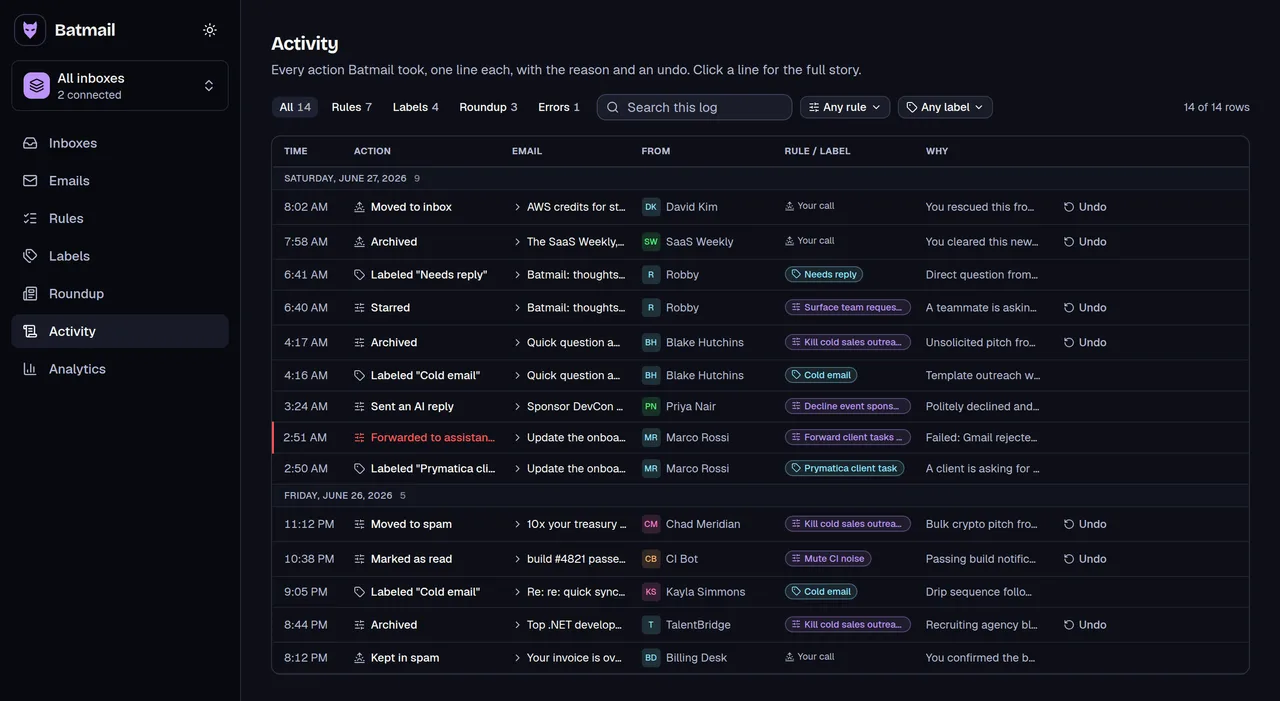
A bounce is one email about another. Batmail reads everything that lands in your Gmail overnight, sorts it by what it is, and puts the few emails that need you at the top of one morning brief.
More free tools
There are more free tools here.
All free, all without an account.