Free tool, no signup
Free email greeting picker
Say who you are writing to and how formal it is. Get the right greeting, a first line and the greetings to avoid.
Your greeting
Hello Mira,
Polite and modern for a first email in most workplaces.
Hello Mira,

I am getting in touch about the spring catalogue.
These also fit:
- Dear Mira,A little more formal, and still personal.
- Hi Mira,Fine when their own emails or profile use a relaxed tone.
Avoid these here:
- Hey Mira,Too casual for someone you have never met.
- To whom it may concern,Sounds like a form letter when you already know the name.
This tool handles one email. Batmail handles the rest.
Continue with GoogleHow to use it
Here is how to pick a greeting in under a minute.
The greeting and the first line change with every choice, so you can compare them side by side.
- Choose who you are writing to: someone you know, someone you have not met, someone senior, a group, or a role with no name.
- Choose the tone you want the whole email to have.
- Say whether this email starts a conversation, answers one or follows one up.
- Type their first name, and their title and last name if the email is formal. For a group or a role, type its name, such as Planning team.
- Copy the greeting and the first line, and read the greetings to avoid before you send.
From most formal to most casual
Dear Dr Vance,
Formal, first contact
Dear Mira,
Formal, first names
Hello Mira,
Neutral
Hi Mira,
Everyday work email
Hey Mira,
Close colleagues only
These three emails show the picker's choices.
A first email to a stranger starts with Dear.
Sunniva Brackenlow is writing to a professor she has never met. She picks someone senior, the formal tone and a first email, types Dr, Mira and Vance, and gives the topic as your packaging research. The picker gives "Dear Dr Vance," and the line "I am writing to you about your packaging research."
A reply to a colleague starts with Hi.
Kasimir Aldercott answers a teammate called Mira about the delivery schedule. He picks someone he knows, the neutral tone and a reply. The picker gives "Hi Mira," with the line "Thanks for your note about the delivery schedule." and lists "Dear Sir or Madam," as one to avoid: it reads as a form letter to someone who knows you.
An email to a whole team can use the team's name.
The office manager at Hallowmere Print Co writes to the planning team about the holiday rota. She picks a group, the friendly tone and a first email, and types Planning team. The picker gives "Hi all," first, "Hi Planning team," as an alternative, and warns against "Hey guys,".
Three situations, three openings
Dear Dr Vance,
I am writing to you about your packaging research.
Hi Mira,
Thanks for your note about the delivery schedule.
Hi all,
I wanted to reach out about the holiday rota.
These are the greeting mistakes readers notice.
The name is spelled wrong.
Copy the name from their signature or their last email. A misspelled name in the first word undoes a careful message.
The greeting is colder than the relationship.
Dear Mr Aldercott to someone who signs his emails Kasimir reads as distant, or as a sign that something is wrong. Match the way they write to you.
The greeting guesses who is reading.
Dear Sir and Hey guys assume who will read the email. Use a name, a role, a team or everyone.
The first line is a pleasantry.
I hope this email finds you well tells the reader nothing. Put the reason for writing straight after the greeting.
Two other free tools finish the email.
- The professional email rewriter tidies the message under the greeting.
- The email signature generator makes the block that ends it.
Questions
These are the questions people ask.
The answers worth having before, and after, you use the tool.
How should I start a professional email?
With a greeting that matches how you would speak to the person and their name: Dear for formal mail, Hello for neutral mail, Hi for people you know. Then give the reason for writing in the very next sentence.
Is Hi too casual for a work email?
Not in most workplaces. Hi with a first name is the everyday greeting between colleagues and with anyone who writes to you that way. Use Dear for a first formal approach, a senior person you have not met, or anything legal.
What can I write instead of To whom it may concern?
A name, if you can find one. If you cannot, write to the team or the role, such as Dear Hiring Committee or Hello Support Team. Hello on its own also works.
Does a comma go after the greeting?
Yes, in most business email: Hi Mira, then the message on a new line. A colon after a formal greeting, as in Dear Dr Vance:, is the style of a formal American business letter.
How do I greet a group?
Hi all, Hello everyone or Hi team for people you work with, and Dear colleagues or the group's own name for formal mail. Avoid greetings such as Hey guys that leave some readers out.
Is anything I type sent anywhere?
No. The greeting is picked in your browser from rules a person wrote. Nothing you type leaves this page.
This tool handles one email. Batmail handles the rest.
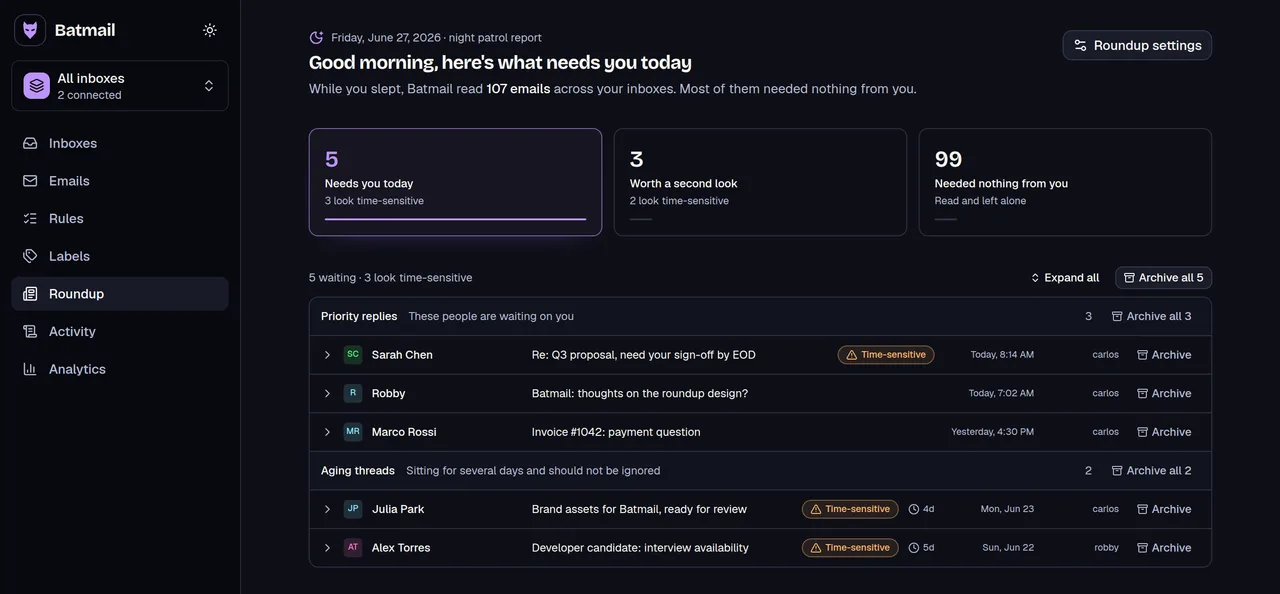
The greeting is the first thing you write. Batmail reads the first lines of everything that arrives overnight and puts the few emails that need a reply at the top of one morning brief.
More free tools
There are more free tools here.
All free, all without an account.